




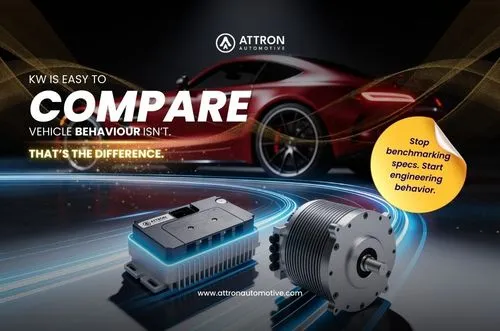
"We need 8 kW." "What is the peak torque?" "Send the datasheet."
These are the standard ways to start a conversation in the electric vehicle industry. But more often than not, they are the wrong questions. Kilowatts are easy to line up on a spreadsheet, but vehicle behaviour is a different story. When you rely only on those peak numbers from a brochure, you are essentially gambling on how your vehicle will actually feel and perform once it hits the real world.
The industry is obsessed with peak numbers because they look great on marketing slides. The reality is that a datasheet only tells you what a motor can do in a brief, 30-second burst. It tells you almost nothing about how that motor will handle a steep climb under a heavy load on a hot afternoon.
Here is the bottom line: Torque is not something you select from a catalogue. Torque is something you engineer.
Two motors can both boast 8 kW on a spec sheet, but they are rarely equal. One might be a highly optimised, robust unit designed to thrive in real-world conditions, while the other might be a peak-only motor that will quickly overheat the moment it faces sustained resistance.
If you are only benchmarking peak numbers, you are missing the bigger picture. Real-world performance is not defined by what a motor can do for a fleeting moment. It is defined by what it can sustain without triggering a thermal shutdown. When a motor is pushed past its continuous torque rating, it does not just lose power.
It hits a thermal limit where it has to throttle performance to protect its windings and magnets. If your motor choice ignores your actual duty cycle, you are not really engineering a vehicle. You are just shopping for a number that might fail you exactly when you need it most.
To build a vehicle that actually works, you have to look past the marketing hype and focus on the physics of the environment. Every vehicle design is a matrix of variables that, when ignored, lead to underpowered and overheating systems. You have to consider:
If your torque requirement is not derived from the actual physics of your application, the number on the datasheet is meaningless. To get it right, you have to work backwards from the vehicle mission profile. You need to calculate based on gross vehicle weight, target acceleration, expected gradability, continuous climb duration, and the thermal steady state where heat generation and dissipation reach a balance. If you do not reach this balance at your required load, your vehicle will fail during a long climb.
It is worth noting that the motor does not act alone. Performance is limited by the controller’s ability to provide current and the battery’s ability to discharge it. High-quality electric drive technology considers the total system integration.
A trusted electric vehicle motor supplier knows that performance isn’t in a single part, it’s in how the whole drive system works together.
The real engineering happens in how the controller manages phase currents to keep the motor in its "happy place", the zone of highest efficiency and lowest heat, for as long as possible.
At Attron Automotive, we know that a motor is only as good as its ability to perform in the real world. A motor that hits its thermal limits after two minutes of climbing is not an 8 kW motor; it is a liability.
It is time to move beyond the brochure. Stop asking for peak numbers and start asking if this motor can sustain the required torque for your longest, toughest duty cycle. The difference between a successful vehicle design and a failed one is the ability to look past the peak and understand the endurance. Stop settling for the brochure. Start defining your own vehicle behaviour.


Questions? Reach us
Monday – Friday from 9 am to 6 pm
Plot no. 41/1, D-II Block, MIDC, Chinchwad, Pune, Pimpri-Chinchwad, Maharashtra 411019


