




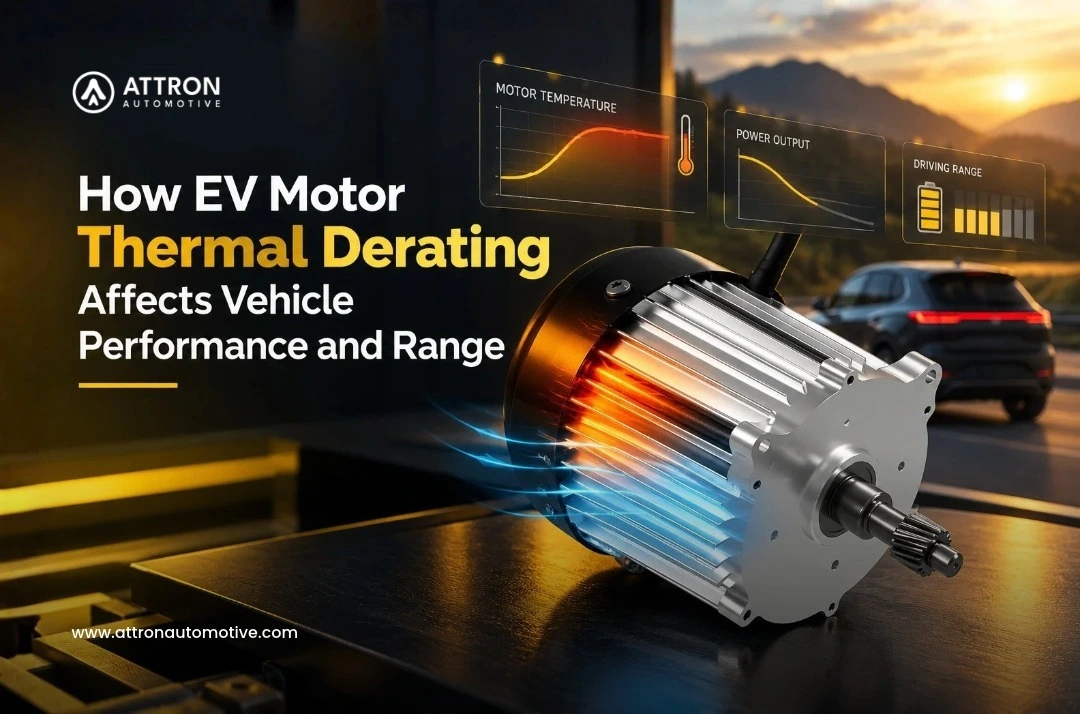
An EV can have a powerful motor, a capable battery, and an efficient motor controller, but it can still lose performance in high temperatures. One of the primary reasons is EV motor thermal derating.
Thermal derating is the reduction of motor output when the motor or associated components become too hot. This is a protective measure to prevent excessive heat from damaging the motor, insulation, bearings, magnets, power electronics or other critical components.
Thermal derating isn’t just a temperature issue for EV manufacturers and OEMs. It directly affects acceleration, hill climbing ability, continuous torque, driving range and overall driving comfort.
That’s why effective EV motor thermal management needs to be considered early in the motor and vehicle development process, not as an afterthought.
Heat is generated whenever an electric motor turns electrical energy into mechanical power. This heat generation can be increased by higher current, heavy loads, frequent acceleration, steep grades, high ambient temperatures and long operation.
If the motor reaches a pre-set thermal limit, the control system is able to reduce the current or torque output. This reduction is known as EV motor thermal derating.
For example, an EV may initially provide its expected torque during acceleration. However, after prolonged operation on a steep road, the motor temperature can rise sufficiently to cause the controller to limit current. Then the vehicle can lose power, even when the accelerator pedal is still pushed.
The idea is to not waste performance. It is to protect the propulsion system and maintain operation within safe thermal limits.
Many factors contribute to motor temperature.
Electrical is a major source of loss. Copper losses increase with current, and iron losses can become significant as motor speed changes. Heat is also produced by mechanical losses and losses in the magnetic parts of the motor.
The environment around it also matters. In hot climates, an EV has less opportunity to reject heat to the environment.
Other considerations include:
Thus two cars with similar motors may behave differently thermally depending on their weight, gearing, driving conditions, cooling system and control strategy.
The most obvious effect of thermal derating is less motor output.
The controller can limit the available torque when the motor reaches its thermal limits. The vehicle is still able to accelerate, but the response of the accelerator pedal may be noticeably slower.
This may be important when passing, merging into traffic, or accelerating from a stop.
Hill climbing can be a heavy load for the electric motor. A long incline can require high torque for a long time unlike a short acceleration event .
As the temperature increases the available torque may be gradually reduced by thermal derating. This means the vehicle may climb slower or have difficulty maintaining the same speed.
This is especially critical for electric two-wheelers, three-wheelers, commercial EVs and vehicles operating with heavy payloads.
Peak torque is great for short bursts, but in the real world you need torque for much longer periods of time.
In the real world, a motor might be able to deliver a high peak torque, but if it can’t sustain the output due to thermal limits, the car’s performance will be very different from the headline specs.
This is where continuous torque engineering comes into play. Engineers are interested in how much torque the motor can provide in real-world operating conditions, not just the peak number it can hit for a moment.
Thermal derating can also affect the consistency of the vehicle's response to the accelerator.
Where torque is progressively reduced as temperature rises, the driver may notice that the vehicle feels different after a long run from the start of the journey.
A good propulsion system design will take care of this transition in a predictable manner instead of having a sudden or unexpected change in performance.AS
Thermal derating doesn’t always mean the vehicle is instantly using more energy. Indeed, suppression of motor output is often designed to protect the system and to control energy and heat.
However, thermal conditions can have an indirect impact on real-world range.
Running a motor outside of its efficient thermal region can increase electrical losses. Often running with heavy loads can also increase the energy needed to keep the vehicle running.
If thermal limitations reduce vehicle speed or acceleration capability the driver may compensate by changing driving behaviour. Frequent throttle changes, longer travel times and repeated operation under high-load conditions may affect overall energy consumption.
Therefore, the relationship between temperature and range is a function of the entire vehicle system, not just the motor.
Actual range is influenced by battery temperature, motor efficiency, controller losses, ambient temperature, vehicle weight, aerodynamics, tyre resistance and driving conditions.
Effective EV motor thermal management aims to control and remove heat before temperatures exceed critical limits.
Thermal management can include, depending on the application:
It’s not just about keeping the motor as cool as possible. Instead, engineers need to keep the motor within an acceptable operational temperature range but still hit performance, efficiency, size and cost targets.
The thermal performance starts with the right motor for the vehicle.
Improperly sized EV motors can lead to excessive thermal stresses. If a motor is undersized, it may need to be run closer to its maximum capability for longer periods of time, especially when carrying a heavy load or climbing a slope.
In contrast, choosing a much larger motor can add unnecessary cost, weight and packaging restrictions.
As such, motor sizing should take into account expected duty cycle, payload, road conditions, speed requirements, acceleration targets, ambient temperature and the cooling ability of the vehicle.
The goal is to match the motor’s operating envelope to the actual needs of the vehicle.
Simulation can help predict motor temperature, but physical validation is still required.
EV motor testing has the capability to measure motor performance under real-world operating conditions including steady load, peak load, repeated acceleration, high speed operation and high ambient temperatures.
Tests can reveal:
This data allows the engineers to build a more accurate thermal approach before the propulsion system has entered production.
Thermal derating is managed by the EV motor controller , which is the key component .
The controller receives temperature and operational data and can change current, torque and other parameters when thermal limits are reached.
A well-calibrated controller can improve the predictability of thermal protection. Instead of waiting for the motor to reach an extreme temperature, the system can control the output gradually according to the temperature trends and operating conditions.
Therefore the motor and controller must be developed as a coordinated system, not as completely independent components.
IPM motors are increasingly used in EV applications because of their combination of torque density, efficiency, and high-speed operating capability.
However, motor topology alone does not eliminate thermal challenges. The actual thermal behavior depends on the motor design, materials, operating point, cooling system, control strategy, and application.
For this reason, selecting an IPM motor should involve evaluating its complete operating envelope rather than looking only at peak power or peak torque.
Thermal derating management is best handled during the entire propulsion system design process.
Engineers should evaluate:
This approach allows manufacturers to know not just what the motor can produce for a few seconds, but what it can reliably deliver over an actual drive cycle.
Attron Automotive is an EV motor manufacturer in India, delivering electric propulsion solutions engineered for motor performance, controller integration, energy efficiency, and application-specific demands.
For OEMs, the most important thing is that a motor’s rated output is just one aspect of its real-world performance. The thermal behaviour determines how much of that performance can be maintained.
Thermal derating of EV motors is not just an electric motor limitation. This is a crucial safety feature to prevent damage to the propulsion system from excessive temperature.
Meanwhile, frequent or aggressive thermal derating may affect acceleration, hill-climbing, continuous torque, driving response and practical vehicle performance.
Therefore, thermal management must be considered for EV motors from the very start of the motor selection and vehicle development process.
Proper motor sizing, realistic duty cycle analysis, effective cooling, controller calibration and thorough testing can assist in reducing avoidable thermal constraints.
The goal for EV OEMs should not be to eliminate thermal derating altogether. Instead, the aim is to develop a propulsion system which reliably, efficiently and consistently provides the performance required under the actual operating conditions encountered.
EV motor thermal derating is the reduction of motor output, usually torque or current, when the motor or related components approach predefined temperature limits. It helps protect the propulsion system from excessive heat.
Thermal derating can indirectly influence real-world range, but the effect depends on the motor, controller, battery, cooling system, vehicle load, ambient temperature, and driving conditions. Derating itself is primarily a protective strategy.
An EV motor can overheat because of high current demand, prolonged high torque, heavy vehicle loads, steep inclines, high ambient temperatures, insufficient cooling, or operation outside its intended duty cycle.
Thermal management can be improved through appropriate motor sizing, effective cooling, optimized motor design, temperature monitoring, controller calibration, improved heat dissipation, and real-world thermal testing.
Usually, peak torque is available for a limited period. Continuous torque is determined by the motor's thermal capability and operating conditions. Therefore, peak torque should not be treated as equivalent to continuous performance.
The controller monitors operating conditions and can reduce current or torque when thermal limits are approached. Proper controller calibration helps provide predictable protection while maintaining as much useful performance as possible.
Testing of EV motors confirms how well the motor performs under real-world operating conditions. It can identify temperature rise, continuous torque capability, cooling efficiency, derating limits, and thermal recovery behaviour prior to production deployment.


Questions? Reach us
Monday – Friday from 9 am to 6 pm
Plot no. 41/1, D-II Block, MIDC, Chinchwad, Pune, Pimpri-Chinchwad, Maharashtra 411019


