




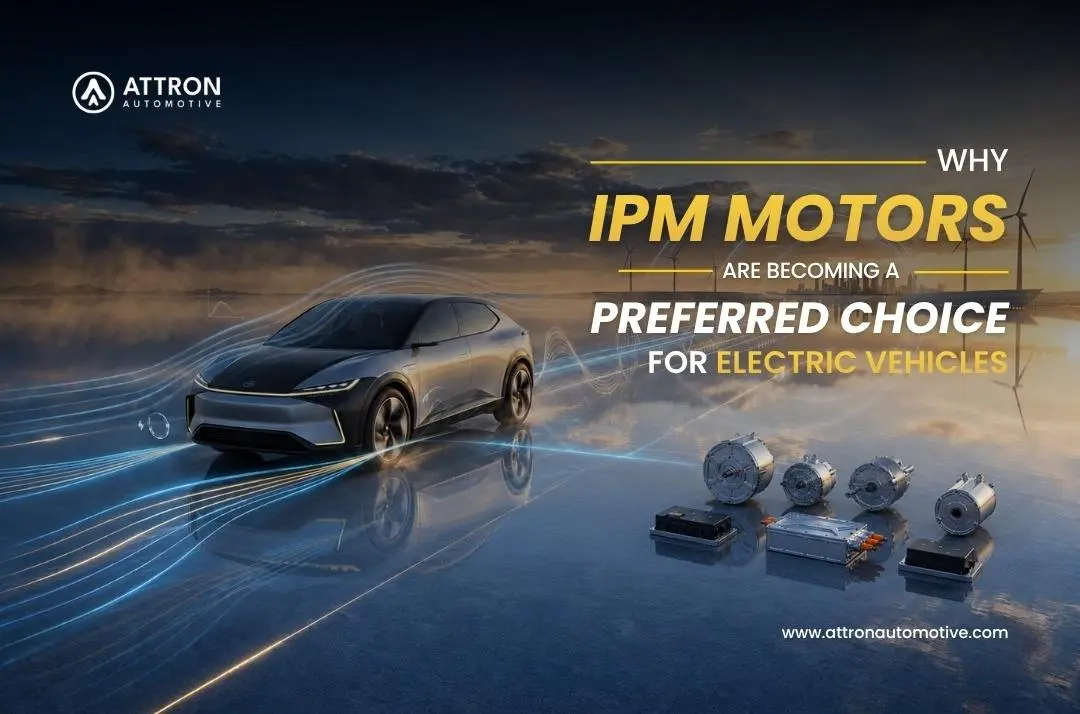
If you’ve looked into electric vehicle technology recently, chances are you’ve seen the term “IPM motor” more than once. That’s because there is a good reason. As EV manufacturers push for better range, smoother performance and lower running costs, IPM Motors have quietly become one of the most talked-about components under the hood (or rather, under the chassis) of modern electric vehicles.
But what exactly makes IPM motors so special, and why are so many automakers, fleet operators, and EV startups shifting toward them? Let's break it down in plain language.
IPM stands for Interior Permanent Magnet. In simple terms, an IPM motor is a type of synchronous electric motor where permanent magnets are embedded inside the rotor core, rather than mounted on its surface. This might sound like a minor engineering detail, but it actually changes how the motor behaves in a big way.
Because the magnets are in the rotor they are better protected from mechanical stress and demagnetisation at high speeds. This design also allows the motor to take advantage of something called "reluctance torque" in addition to magnetic torque, which means the motor can produce more power without needing a bigger frame or heavier magnets.
In short, an IPM motor for electric vehicles delivers more performance per kilogram than most conventional motor designs. That's exactly what EV engineers are chasing right now.
Space is always at a premium in EV design. Battery packs, cooling systems, wiring, and motor units all compete for the same limited real estate. IPM motors are naturally compact due to their internal magnet placement, allowing manufacturers to fit more power into a smaller footprint.
This is a major reason why so many two-wheeler and three-wheeler EV manufacturers, alongside passenger car makers, are integrating IPM-based systems into their Motor Control for Electric Vehicle setups.
Heat is the silent killer of any electric motor. Overheated motors are less efficient, die sooner and can be a safety risk also. Since the magnets in an IPM motor are embedded within the rotor, they're inherently better shielded from external heat sources compared to surface-mounted designs. This results in a longer life of the motor and more reliable performance especially when under heavy duty conditions such as stop-and-go traffic or hilly terrain.
If you’ve ever driven an EV, you know that one of the biggest selling points is instant torque. IPM motors are especially good at providing smooth and predictable torque over a wide range of RPM, which translates to a smoother driving experience. Less vibration, less noise and a more premium feel even in budget friendly EV models.
It’s not all about the motor in today’s EVs. They work with a tightly integrated system of EV Motors and Controllers working together to optimize performance, battery usage and thermal behaviour. IPM motors integrate exceptionally well with modern controller software, enabling precise torque mapping, optimization of regenerative braking, and adaptive power delivery based on driving conditions.
This hardware-software synergy is one of the reasons that IPM technology is the preferred choice of engineers designing next-generation EV platforms.
That’s a fair question, especially because terms like BLDC, induction motors and SPM motors are also bandied about a lot in EV circles. Each motor type has its own strengths, but IPM motors tend to strike the best balance between efficiency, power density, and durability, which is exactly what most EV applications need.
Induction motors, for instance, are rugged and cost-effective but generally less efficient at partial loads. Surface-mounted permanent magnet motors offer good torque but can struggle with high-speed demagnetization risks. IPM motors solve many of these trade-offs, which is why they're increasingly favored for everything from electric scooters to full-size electric cars.
India's EV industry is growing fast, and with that growth comes rising expectations from consumers who want better range, lower maintenance and reliable after-sales support. This is leading many companies to look for an EV Motor Supplier they can trust, not only for the motor itself but also for a complete ecosystem of testing, customization and technical support.
With increasing demand, the need for a reliable EV motor manufacturer in India, who understands global engineering standards along with the practicalities of Indian road conditions, temperature variations, and cost sensitivity, also grows. This is precisely where companies like Attron Automotive are coming in with IPM motor solutions tailored to meet the performance and durability requirements of Indian EV manufacturers.
If you're an EV manufacturer, fleet operator, or even a component buyer evaluating your options, the shift toward IPM motors isn't just a passing trend. It reflects a broader move in the industry toward smarter, more efficient, and more compact powertrains that can meet rising consumer expectations.
Choosing the right motor isn't just about specifications on a datasheet. It’s the long-term reliability, the after-sales support and the integration of the motor into your existing control systems. That’s why it’s as important to have an experienced partner as it is to have the technology.
IPM motors are becoming the preferred choice for electric vehicles because they genuinely solve real engineering problems: better efficiency, compact design, improved thermal stability, and smoother torque delivery. As EV adoption continues to grow across India and globally, this motor technology is likely to become even more dominant.
If you're exploring EV motor options for your next project, it's worth partnering with a manufacturer who understands both the technical depth of IPM motor design and the practical needs of real-world EV applications. The right EV Motors and Controllers configuration will deliver the performance, reliability and efficiency customers expect today from your electric vehicle platform. That’s the kind of expertise that Attron Automotive delivers.
They’re very well-rounded. IPM motors offer a good combination of efficiency, power, torque and long term durability. The way the magnets are placed inside the rotor also means these motors can handle high speeds well, which makes it easier for manufacturers to build EV powertrains that are both compact and powerful.
Yes, here’s why: IPM motors derive their performance from two sources at once, permanent magnet torque and reluctance torque. That combination lets them perform strongly without wasting energy. Pair one with the right motor controller and a well-matched vehicle system, and you'll often see fewer energy losses and better use of the battery - which can translate into a longer driving range.
For the most part, yes. IPM motors can be engineered to cope with the kind of driving conditions common in India - heavy stop-and-go traffic, hot weather, steep or hilly terrain, and unpredictable road surfaces. That said, the actual performance of a motor depends on more than just the motor. Big things like cooling system, integration of the controller and general design towards the application.


Questions? Reach us
Monday – Friday from 9 am to 6 pm
Plot no. 41/1, D-II Block, MIDC, Chinchwad, Pune, Pimpri-Chinchwad, Maharashtra 411019


