




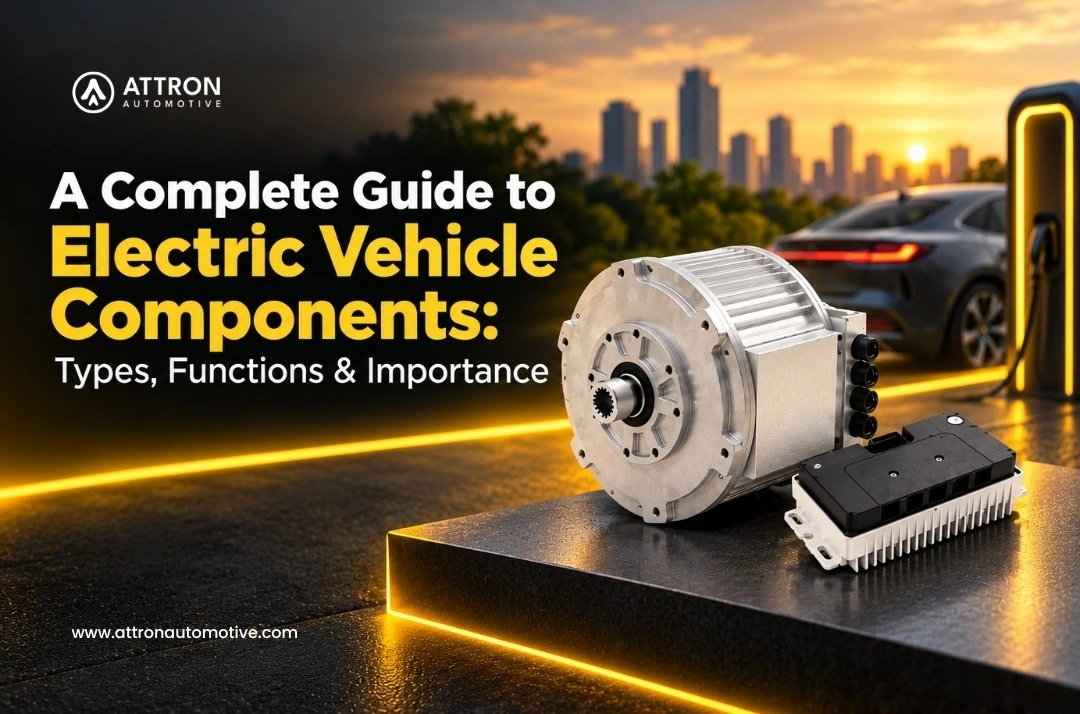
Electric vehicles can be seen everywhere on the roads and even in the parking lots of housing societies and even in the two-wheeler space that was once the domain of petrol bikes, unchallenged. But ask the average person what’s actually in an EV and they’ll give you a blank stare. “It's got a battery, hasn't it?” Yes, but that's like saying that a car "runs on an engine" without mentioning the transmission, the fuel injectors, or the exhaust system.
If you are buying an EV, working in the automotive industry or are simply interested in where the world is going, knowing about Electric Vehicle Components is no longer optional - it is really useful knowledge. In this guide, we'll break down every major part of an EV, explain what it does in plain language, and talk about why each piece matters more than you'd think.
An internal combustion engine (ICE) vehicle has been refined over a century. Everyone from your local mechanic to your uncle who "knows cars" understands roughly how it works. Electric vehicles flip that script. The components are different, the failure points are different, and honestly, the maintenance philosophy is different too.
Knowing your EV's anatomy helps you:
Let's get into the components themselves.
This is the heart of any EV, and for good reason - it's usually the single most expensive part of the vehicle. The battery pack stores electrical energy in chemical form, typically using lithium-ion cells arranged into modules, which are then grouped into a pack with a protective casing.
What actually determines a battery's usefulness isn't just capacity (measured in kWh), but also its chemistry (NMC vs LFP being the most common debate right now), thermal management, and how well it's protected from vibration and moisture. A battery that overheats loses life fast - which is exactly why the next component exists.
Think of the BMS as the battery's personal bodyguard and accountant rolled into one. It constantly monitors voltage, temperature and current across each cell, balancing charge levels and keeping the battery from entering unsafe territory.
Even the best battery chemistry will degrade rapidly without a good BMS, or worse, become a safety hazard. This is one area where cutting corners shows up fast – less range, bad charging behavior, or an early battery death.
Here's where things get genuinely exciting from an engineering standpoint. The electric motor converts electrical energy into mechanical motion - basically, it's what makes the wheels turn. Unlike a petrol engine with hundreds of moving parts, most EV motors (BLDC or PMSM types, typically) have far fewer components, which is part of why EVs need less mechanical maintenance overall.
Motor design directly affects torque delivery, efficiency, noise levels, and how the vehicle handles under load. This is also where sourcing quality really shows. If you're a manufacturer or fleet operator evaluating suppliers, working with an established EV motor manufacturer in India rather than an unverified vendor can be the difference between a motor that lasts and one that needs constant rework.
The motor doesn't work on its own, it requires complex instructions on how much power to draw and when. That’s what the motor controller is for. It takes input from the accelerator, talks to the battery and controls the current flow to the motor in real time.
Some EVs feel jerky at low speeds or sluggish under acceleration, even with a perfectly good motor, due to bad controller calibration. This is why EV Motors and Controllers are so often talked about together; they are a matched pair, not a stand alone component. A powerful motor with a mediocre controller is like a sports car with a bad throttle cable.
The inverter converts DC power from the battery into AC power that most electric motors actually use to run (and converts it back during regenerative braking). It's a small component with a big job, and its efficiency directly impacts how much range you get from a given battery size.
Modern inverters also handle switching frequency and thermal load, which ties closely into overall Motor Control for Electric Vehicle systems - the inverter and controller often work in tandem to deliver smooth, efficient power delivery across different speeds and loads.
When you plug your EV into a regular AC socket, the onboard charger converts that AC power into DC so it can actually charge the battery. This differs from DC fast charging, where the conversion happens externally at the charging station, allowing much quicker top-ups.
OBC capacity (measured in kW) determines how fast your car charges at home or at slower public chargers - a detail many buyers overlook until they're stuck waiting overnight for a full charge.
Most EVs have a single speed transmission unlike petrol vehicles which come with multi-speed gearboxes. Electric motors produce a lot of torque across a broad range of RPMs, so you don’t need the mechanical complexity of gear shifting. Fewer gears mean fewer parts that can wear out-another reason why EVs generally need less frequent mechanical servicing.
Batteries and motors both generate heat, and heat is the enemy of longevity. Thermal management systems - whether air-cooled, liquid-cooled, or a hybrid approach - keep temperatures within safe operating ranges. This is particularly critical in a country like India, where ambient temperatures already push components toward their thermal limits during summer months.
It’s not glamorous, but the wiring harness is the physical link for every electrical component. High-voltage cables require adequate insulation, shielding, and connector quality to avoid energy loss, overheating, or safety failures. A surprising amount of EV problems are caused by bad harnesses, not the "big" components that get all the love.
This system takes kinetic energy during braking or deceleration and feeds it back to the battery rather than wasting it as heat (like traditional friction brakes do). It’s one of the smarter innovations in EV design, increasing range and reducing wear on physical brake components simultaneously.
If you’re a vehicle manufacturer, fleet builder or even a workshop that specialises in EV retrofitting, then component sourcing is no minor decision. It impacts the reliability and reputation of your product. For example, a miscalculation of the motor size can result in a car that is either underpowered or too big and inefficient and thus drains battery capacity.
This is where proper EV Motor Sizing comes in – matching motor specs to vehicle weight, intended use case, and expected load conditions, rather than picking a generic off-the-shelf option. Working with an experienced EV motor supplier that knows these calculations saves money and long-term headaches.
Companies like Attron Automotive have built their reputation precisely around this kind of component-level expertise - offering motors, controllers, and integrated EV drivetrain solutions engineered for Indian road and climate conditions rather than adapted from generic global templates.
EVs aren’t just “cars without engines.” They’re a whole different engineering ecosystem, built around batteries, motors, controllers and smart electronics working together. Having a good understanding of these parts will help you make better decisions, be it buying your first EV, building one or simply trying to keep up with where the automotive world is headed.
As the EV industry matures in India, component quality, not just battery size or brand name, will increasingly distinguish good vehicles from bad ones. Knowing what is under the hood (or under the floor in this case) puts you a step ahead.
The key components are the battery pack, battery management system ( BMS ), electric motor, motor controller, inverter, on board charger, gearbox, thermal management system, wiring harness and regenerative braking system.
Usually the most expensive part, the battery pack often makes up a large percentage of the total cost of the vehicle.
Proper EV Motor Sizing ensures that the motor is sized to match the weight of the vehicle, its intended use and the load conditions. An improperly sized motor may result in poor performance, reduced range, or unnecessary cost.
The motor produces the mechanical power to move the vehicle and the motor controller determines how much power the motor receives based on driver input and battery conditions.


Questions? Reach us
Monday – Friday from 9 am to 6 pm
Plot no. 41/1, D-II Block, MIDC, Chinchwad, Pune, Pimpri-Chinchwad, Maharashtra 411019


