




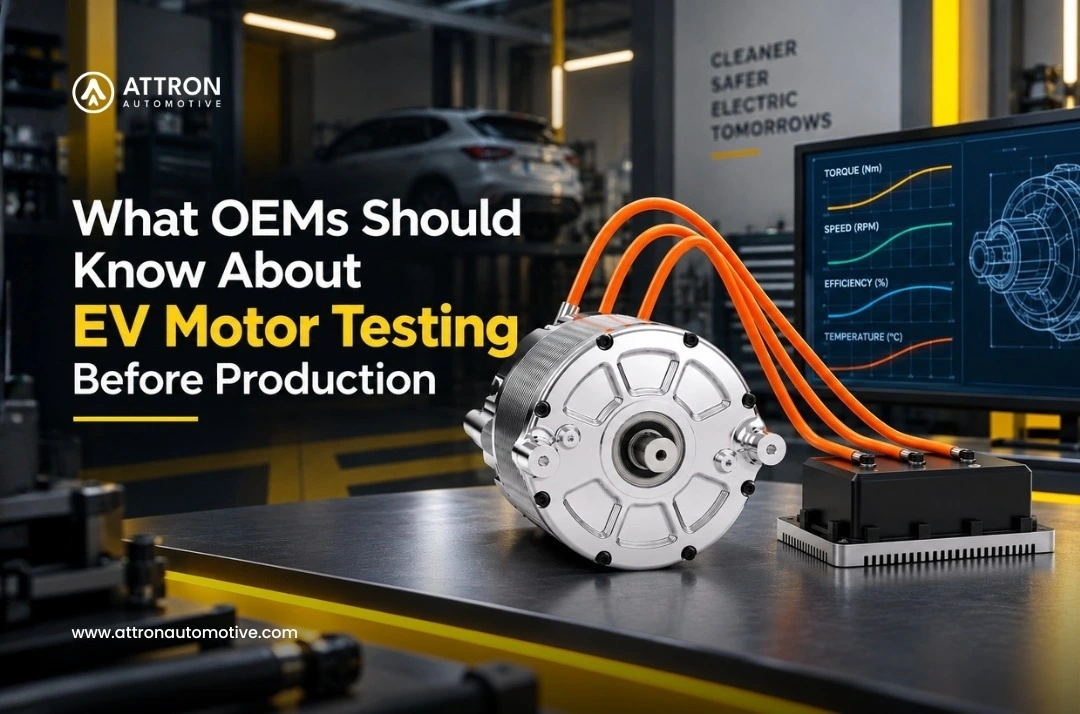
Selecting a motor is just one aspect of developing a reliable EV powertrain for electric vehicle OEMs. “An EV motor needs to demonstrate it can provide the required performance, efficiency, durability and safety in real-world operating conditions before it can go into production. This is where EV Motor Testing comes in.
A motor that performs well in a controlled demonstration might not behave in the same way under continuous loading, temperature changes, vibration, a variety of road conditions or long operating cycles. Rigorous testing allows OEMs to identify these problems before they become expensive production or field problems.
For OEMs working with an EV Motor Manufacturer in India, understanding the testing and validation process can make it easier to evaluate motor performance and choose the best powertrain solution.
The electric motor directly influences several important vehicle characteristics such as acceleration, torque delivery, efficiency, range, thermal performance and reliability.
Pre-production testing allows OEMs to answer practical questions like:
These questions cannot always be answered by specifications alone.
A motor might have a peak power rating that sounds great, but OEMs also want to know how the motor performs over time. This is why the testing must be targeted to both peak and real world operating conditions.
EV Motor Testing is a process to test an electric motor against the specified performance, durability, thermal, electrical and operational requirements.
Testing can occur at various stages of development, from testing of prototypes, to validating pre-production, to checking quality in final production.
Typical testing parameters include:
The precise test procedure depends upon the application of the motor and the vehicle design.
For example, a motor designed for an electric two-wheeler may have different testing requirements from one designed for an electric three-wheeler or commercial vehicle.
Torque is one of the most important parameters of an EV motor as it directly influences the acceleration, hill climbing ability, load carrying and overall drivability.
OEMs need to consider not only peak torque but also torque delivery across the motor’s operating range.
It is also important to know whether the motor can produce its required output without overheating.
But a motor that can produce high peak torque for a short period may not be appropriate for an application that requires sustained performance.
This makes the Continuous Torque an important parameter for comparison of motors used in Commercial and utility oriented EV applications .
Motor efficiency is the measure of the efficiency of converting electrical energy into mechanical power.
Higher efficiency can help reduce energy losses and improve the range of vehicles. Efficiency, however, should not be judged at a single operating point.
OEMs should consider motor efficiency at various:
This gives a more realistic picture of how the motor will perform in everyday driving.
Heat is one of the major factors affecting electric motor performance and durability.
During operation, losses in the motor generate heat. If the motor cannot manage this heat effectively, performance may decrease and components may experience additional stress.
Thermal testing helps determine:
For OEMs, thermal testing is especially important when the vehicle is expected to operate under heavy loads, frequent acceleration, steep gradients, or high ambient temperatures.
Motor evaluation is not only about the peak performance. OEMs should also know how the motor performs when running continuously.
Continuous-load testing determines whether the motor can maintain the required performance for a longer time.
This can expose problems that may not show up during short duration tests such as:
This is all the more important for electric three-wheelers, commercial vehicles and other applications where the motors can be run for long durations.
An EV motor needs to perform well over the speed range it is expected to operate.
Tests should be designed to evaluate motor behaviour at low, medium and high speeds, considering torque and efficiency.
OEMs must also know the operating limits of the motor and how it acts around those limits.
This information helps engineers match the motor to the vehicle’s transmission, wheel size, battery system and expected driving conditions.
The motor cannot be considered separately from its control system.
The EV Controller controls the delivery of electrical power to the motor and affects acceleration, torque response, efficiency, protection and overall drivability.
OEMs should therefore test the motor-controller combination and not just trust the individual component specifications.
Testing should evaluate:
The vehicle can behave more smoothly and predictably with the right motor and controller combination.
EV Motor Validation takes testing one step further. It determines whether the motor actually meets the requirements established for the intended vehicle application.
For example, an OEM may define requirements for:
The validation process compares actual test results against these requirements.
This helps OEMs determine whether the motor is ready for production or whether design changes are required.
Validation should ideally consider the complete operating environment rather than testing the motor in isolation.
A motor may perform well during initial testing but still require long-duration evaluation.
Durability testing helps identify potential issues related to repeated operation, mechanical stress, thermal cycling, vibration, and component wear.
Depending on the application, testing may simulate:
The objective is not simply to prove that the motor works. It is to determine whether it can continue working reliably throughout its expected operating life.
PMSM Motors are widely used in modern EV applications because of their combination of efficiency, torque density, and controllability.
However, selecting a PMSM motor based only on its rated power is not enough.
OEMs should evaluate:
The right PMSM motor should be selected according to the complete vehicle requirement rather than a single specification.
Before finalizing an EV Motor Supplier, OEMs should ask for more than a product datasheet.
Important questions include:
Clear answers to these questions can help OEMs make better engineering and sourcing decisions.
Testing before production can help identify problems when they are still relatively easy to address.
Identifying a thermal problem during development is a lot better than discovering it after thousands of vehicles are already on the road.
Similarly, identifying controller compatibility issues during validation can prevent costly production changes.
OEMs can minimise by following a structured testing and validation process:
So testing is not only a technical requirement for the OEMs. It is part of managing product quality and long-term reliability.
The testing capability of the supplier is an important consideration when developing an electric vehicle.
The experienced EV Motor Manufacturer in India should be able to understand the requirements of the vehicle and support the OEM beyond just supplying a motor.
At Attron Automotive we develop solutions for EV motor & controller for applications in electric mobility. The goal for OEMs should be to evaluate the entire powertrain on real vehicle requirements, operating conditions and expected performance.
Validation is required before any production decisions are made, whether the application requires high torque, efficient operation, continuous operation or reliable motor-controller integration.
Choosing an EV motor should never be based solely on peak power, price, or a product datasheet. The motor needs to demonstrate that it can perform consistently under the conditions expected in the final vehicle.
A comprehensive EV Motor Testing process helps OEMs evaluate torque, efficiency, thermal behavior, durability, speed range, and controller compatibility. EV Motor Validation then confirms whether those results meet the vehicle's actual engineering requirements.
By completing the right tests before production, OEMs can make more confident powertrain decisions, reduce development risks, and build EVs designed for reliable real-world performance.
For OEMs evaluating EV Motors and Controllers, working with a capable supplier such as Attron Automotive can help create a more structured path from motor selection and testing to production readiness.
EV Motor Testing is a process to evaluate the performance, efficiency, thermal behaviour, durability, torque, speed and reliability of an electric motor under defined operating conditions.
EV Motor Validation is the process of confirming that the motor meets the specific performance and reliability requirements of the intended vehicle prior to production.
Important parameters include torque, power, efficiency, speed, temperature, continuous operation performance, durability, electrical behaviour, vibration and motor-controller compatibility.
OEMs should enquire about testing procedures, torque ratings, efficiency, thermal performance, durability testing, controller compatibility, validation data, and the supplier’s ability to meet vehicle-specific requirements


Questions? Reach us
Monday – Friday from 9 am to 6 pm
Plot no. 41/1, D-II Block, MIDC, Chinchwad, Pune, Pimpri-Chinchwad, Maharashtra 411019


