




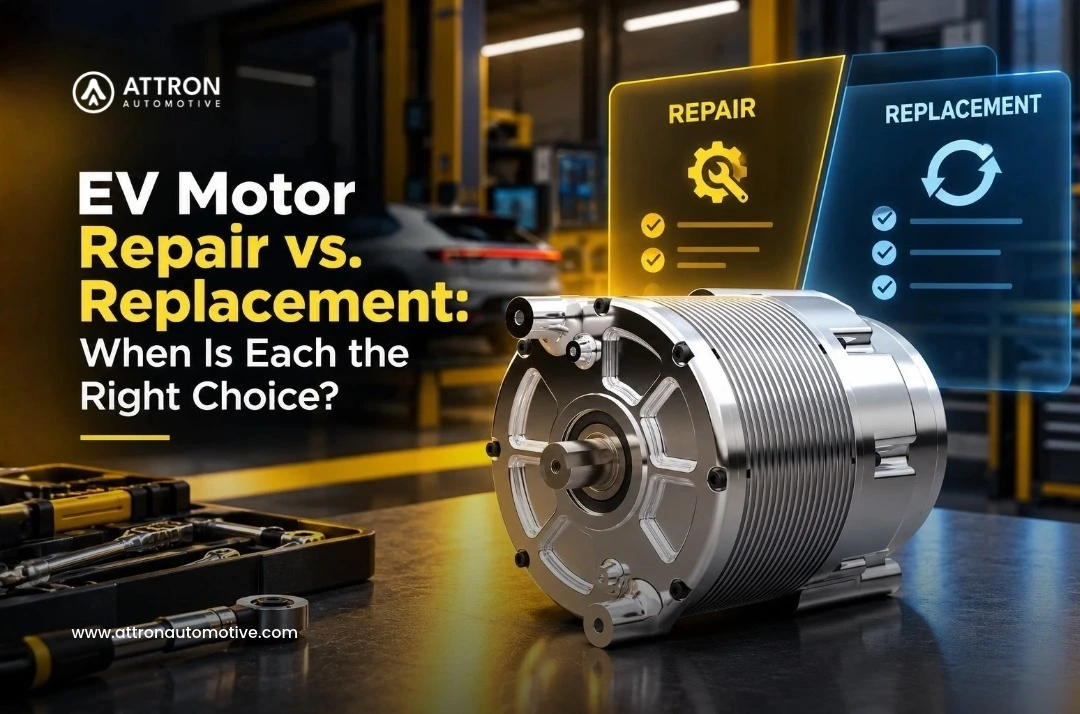
Electric vehicles are designed to be efficient, smooth and reliable. But like any mechanical or electrical system their motors can run into problems as they age. Weird sounds, no acceleration, overheating or loss of power can leave vehicle owners wondering if they need EV motor repair or a complete replacement.
Making the right decision is important if you want to control maintenance costs, keep your vehicle performing well and avoid breakdowns over and over again. A small part of a motor may be defective, yet you replace the entire motor, adding unnecessary expense. However, fixing a severely damaged motor may result in the problems reoccurring and more downtime.
So how do you know what is the right choice for your electric vehicle?
Let's look at the distinctions between EV motor repair and electric motor replacement, some warning signs to be aware of, and what should influence your decision.
EV motor repair involves the diagnosis and correction of a specific failure in the electric motor or its related components. Instead of swapping out the entire motor assembly, technicians will check the system to see if the problem can be fixed by swapping out or repairing specific parts.
Depending on the design of the motor and the extent of the damage, repairs may include replacing bearings, repairing electrical connections and sensor faults, restoring cooling performance, or repairing damaged windings, where technically feasible.
For example, a worn bearing can cause strange motor noise on an electric scooter. If the windings or rotor or other major components are in good shape, a new bearing may get it back to normal operation without a new motor.
But not every motor problem can be solved with a simple repair. The first step should always be to have a proper technical diagnosis.
Electric Motor Replacement is the removal of a bad motor and the installation of a suitable replacement unit. Depending on the vehicle design this could mean replacing only the motor or an integrated drive unit.
When the existing motor has significant internal damage, is not technically feasible to repair, or the cost and the reliability of repair no longer make sense, replacement is generally the option .
Electric vehicle makers and OEMs need to pay more attention to motor specs, controller compatibility, mechanical integration and vehicle-level performance needs when considering replacement options.
Burned windings, extensive insulation failure or a confirmed internal electrical short can make repair difficult or uneconomical. Some motor designs may be rewindable but this is an issue depending on the extent of damage, availability of specialist services and the repair guidelines of the manufacturer.
The basic parts of an electric motor are the rotor and stator. Performance and reliability can be affected by severe deformation, physical damage, or permanent magnet degradation. If the damaged components cannot be brought back to the required specifications, replacement might be more appropriate.
If the same motor continues to have problems after proper repair work, it is worth investigating whether the underlying damage is greater than initially determined. Doing repairs repeatedly can increase your down time and maintenance costs, so replacing is a better value in the long run.
Some motors have special parts that are difficult to obtain individually. If the parts needed are discontinued or just not available, it might be easier to just replace the entire motor with a compatible one.
If the repair cost is near the cost of a suitable replacement, then look at the expected service life of both. If a replacement can reduce the chance of repeated failures and be backed by a good warranty, it might be better value in the long run.
The right choice depends on the motor's condition, repair feasibility, and total ownership cost.
Neither option is automatically better. A well-executed repair can restore reliable operation, while a compatible replacement can be the safer investment when the original motor has sustained extensive damage.
One of the most common mistakes in motor maintenance is to decide to repair or replace a motor on the basis of symptoms alone.
Lowered acceleration, overheating, odd noises and power interruptions are not always motor failure. Other parts of the drivetrain like the controller, the sensors, the electrical connections, the cooling system can also cause similar symptoms.
Testing the EV motor is so important before you make a big maintenance decision, that’s why.
A professional evaluation can include:
Visual inspection - Check for physical damage, corrosion, loose connections, and signs of overheating.
Electrical Testing: Testing winding resistance and insulation condition by suitable procedures and equipment.
Mechanical inspection: Bearings, rotor movement, vibration and unusual operating noise.
Temperature check: Checking for overheating and ensuring the cooling system is working properly.
Controller diagnostics: Inspection of relevant fault codes and operating data to differentiate motor faults from control-system issues.
Performance verification: to check the motor's performance within its specified electrical, thermal and mechanical limits.
Tests are specific to the motor design and the manufacturer’s specifications. High voltage components should only be inspected or serviced by properly trained personnel.
The motor and controller work together to deliver the required torque and speed. The controller regulates electrical power supplied to the motor, helping the vehicle respond to acceleration demands and operating conditions.
A faulty EV motor controller can cause symptoms such as inconsistent acceleration, reduced power, warning indicators, or unexpected shutdowns. These problems may initially appear to indicate motor failure.
Replacing the motor without checking the controller can leave the original problem unresolved.
Before approving a replacement, technicians should establish whether the fault originates in the motor, the controller, the associated wiring, or another part of the drive system. This is particularly important for integrated motor-controller systems, where compatibility and coordinated operation affect overall performance.
Before you decide on EV motor repair or replacement, consider the following factors.
Compare the total cost of the repair quote to the cost of a compatible replacement. Includes parts, labour, diagnostic charges, testing and any associated component repairs
A motor with a good service history and only one isolated fault may be a good candidate for repair. Heavy wear or repeated failures may warrant replacement of a motor.
Verify the motor is covered under the vehicle or component manufacturer’s warranty. Depending on the terms of the warranty, coverage may be affected by unauthorised repairs or disassembly.
The replacement motors must meet the electrical, mechanical, thermal and control requirements of the vehicle. Just because a motor fits physically , does not mean it will work for your application .
Consider the expected service life after the repair, the availability of technical support, and the consequences of future downtime. For commercial EV fleets, delivery vehicles and electric three-wheelers, reliability is as important as the immediate repair bill.
If the current motor is consistently not meeting the application requirements, then replacement may be an opportunity to re-evaluate the motor specification. IPM motors can be considered for suitable applications where high torque density and efficiency are relevant. But switching motor technology is not a simple case of swapping one for another. It calls for careful engineering and compatibility checks.
For OEMs, decisions concerning motor maintenance affect operating costs, vehicle availability, customer satisfaction and product reliability.
OEM's need to have a consistent evaluation process that covers fault diagnosis, component level testing, repairability, replacement costs and post service validation.
Teamwork with a technically proficient EV Motor Supplier can also help OEMs to access appropriate motor configurations, application guidance and relevant engineering support.
Companies that are looking to select a new drivetrain or replace a motor can benefit from choosing an experienced EV motor manufacturer in India. This can help ensure better matching of motor specifications with vehicle requirements.
Attron Automotive develops electric motor and controller solutions for EV applications with a focus on performance, efficiency and application-specific needs. For OEMs looking at motor systems, choosing the right technology and ensuring compatibility with the vehicle platform are important parts of building a reliable electric drivetrain.
The decision between EV motor repair and electric motor replacement is based on evidence, not assumptions.
Where the fault is localised and the main motor components are serviceable and the repair can restore the required performance, repair is often the sensible choice. Replacement is more appropriate in case of serious internal damage, repeated failures, unavailable components or repair costs that no longer justify the expected result.
Most important-diagnose first, compare total costs, and test the system before returning the vehicle to service. This approach avoids unnecessary costs while ensuring safety, performance and long-term reliability.
A well-informed decision can make a meaningful difference to the overall cost and reliability of electric mobility for both EV owners and OEMs.
“Yeah. If the problem lies in a serviceable portion of the EV motor such as a bearing, sensor, electrical connections, or some winding issues, it can often be repaired. Whether this is possible depends on the design of the motor, the extent of the damage and the availability of qualified repair services.
Either part can cause problems such as loss of power, jerking, overheating and inconsistent acceleration. Problem source actually determined via professional diagnostics, fault code analysis, electrical measurements and motor testing.
The price depends on the model of vehicle, type of motor, power rating, availability of components, labour and warranty cover. A complete replacement will typically cost more than a minor fix, but a full diagnosis and written estimate are needed to accurately compare the options.
“Yes. Testing helps to identify whether a fault is within the motor itself or in an associated component, such as the controller, wiring or cooling system. It also helps to find out if repair can bring the motor back to its required operating condition.
OEMs should consider rated power, continuous torque, operating voltage, efficiency, thermal performance, mechanical integration, controller compatibility and application requirements. Choosing a technically experienced motor supplier will help you make sure the replacement matches the vehicle's design specifications.
It can, provided the fault has been correctly identified, the repair is carried out to the required specifications and the motor passes appropriate validation tests. Performance and remaining service life however depend on the original damage, the repair process and condition of other components.


Questions? Reach us
Monday – Friday from 9 am to 6 pm
Plot no. 41/1, D-II Block, MIDC, Chinchwad, Pune, Pimpri-Chinchwad, Maharashtra 411019


