




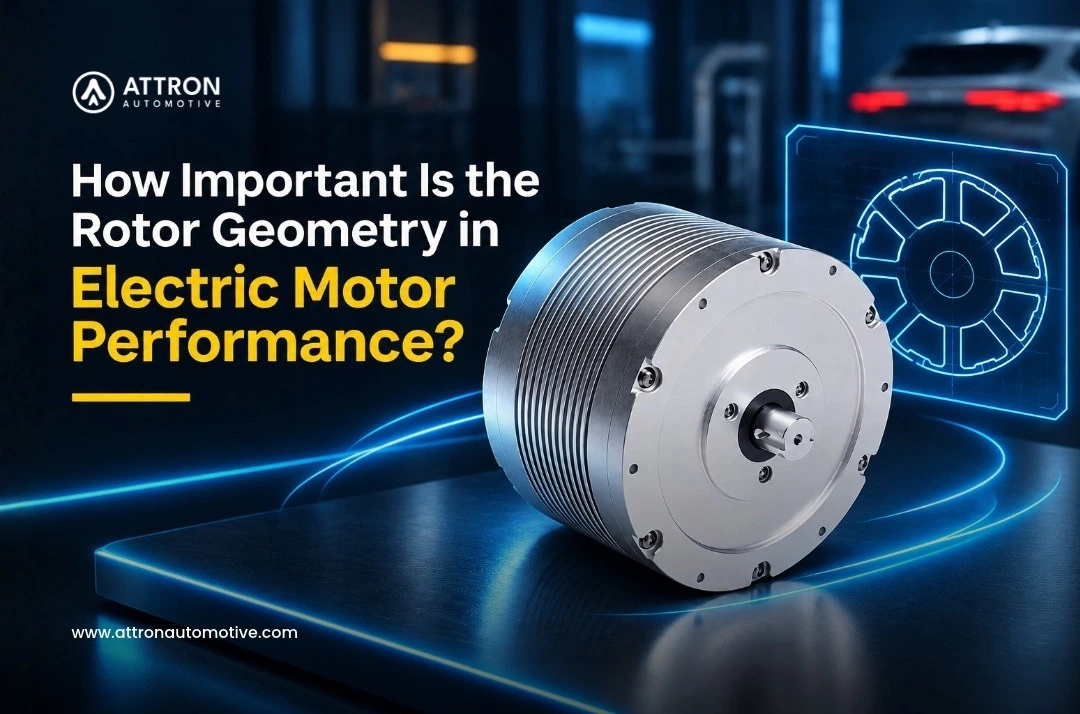
When considering an electric motor, most people look at the power output, torque and efficiency. But these performance numbers depend on some engineering decisions inside the motor. An important factor is the design of the rotor.
The rotor is turned by electromagnetic interaction with the stator. The shape and size of the motor, the magnetic arrangement, and the structural configuration all influence the efficiency with which a motor converts electrical energy to mechanical power.
Hence, the design of electric motor rotors is a key factor in the creation of contemporary electric vehicles. Even small changes in rotor geometry are able to affect the torque delivery, the efficiency of energy utilization, the operating speed, the production of heat and the overall reliability of the motor.
For EV manufacturers, understanding how rotor geometry influences motor behavior can help in selecting the right motor technology for different vehicle applications. Now let’s look at why rotor design is important, and how it contributes to better electric motor performance.
The rotor is the spinning component of an electric motor. It works in conjunction with the stator, which are the stationary windings that create the magnetic field.
The rotor geometry is the structure and arrangement of the rotor. It includes diameter, length, shape, magnet location, slots, internal flux paths etc.
These design features determine the path of the magnetic flux within the rotor and its interaction with the stator.
Some important things in rotor geometry are:
Rotor diameter and length: Affects the torque characteristics and overall size of the motor.
Magnet configuration: It determines how the permanent magnets are interacting with the stator's magnetic field.
Air gap: Distance between rotor and stator affects the electromagnetic interaction.
Flux barriers: Guide the magnetic flux in the rotor to specific paths.
Rotor material: Affects the magnetic properties, mechanical strength and thermal behavior.
Shaft configuration: Mechanical stability and power transmission.
All these factors together decide how efficiently a motor works at different load and speed conditions.
Rotor geometry is not just a matter of the way a motor’s internal components look. It affects directly a number of important performance characteristics.
Torque is the amount of rotational force an electric motor can generate. Electric vehicles require sufficient torque for acceleration, climbing slopes, carrying passengers and handling extra loads.
The rotor's geometry determines how magnetic fields in the stator act on it to produce this rotational force.
For example, the location of permanent magnets, the configuration of rotor poles, and the flux paths can affect the size and distribution of electromagnetic torque.
A well designed rotor can help to achieve:
This is especially important for electric two-wheelers and three-wheelers where the motors have to respond well to frequent acceleration and changing load requirements.
Efficiency is one of the most important factors in the performance of an electric vehicle. A motor which converts a higher percentage of electrical energy to mechanical output can help reduce unnecessary energy consumption.
To achieve this balance, the magnetic structure of the rotor plays an important role.
A good magnetic flux distribution can improve magnetic utilization and reduce some electromagnetic losses while a bad magnetic flux distribution can cause some additional losses.
Advantages of a good rotor geometry can be:
These improvements can help better optimize the use of battery energy and possibly lead to increased driving range for electric vehicles.
But actual efficiency is also a function of stator design, winding arrangement, controller performance, cooling and operating conditions.
One of the common challenges in electric motor operation is heat. Higher thermal stress is experienced by the internal components of the motors when they are heavily loaded or they run at high speeds.
The rotor geometry can affect the distribution of magnetic losses and the heat generation in the rotor assembly.
Thermal behavior is a function of magnet positioning, material selection, rotor thickness, and internal structural arrangements.
Temperature control is especially important in permanent magnet motors since excessive heat can affect magnet performance and long-term reliability.
Thermal limitations must be considered in addition to torque and efficiency requirements for effective rotor design. This allows the engineer to design motors that can operate reliably under severe operating conditions.
Most electric cars built today require motors that can operate across a wide range of speeds.
But then you have also the added mechanical stress from the higher rotational speeds. The higher the rotor speed, the higher the centrifugal forces acting on the rotor body, shaft, magnets and supporting structures.
If the rotor is not designed to withstand these forces, it may deform too much, vibrate or fail mechanically.
When designing rotors for high speed applications engineers take a number of things into consideration:
The mechanical stability is provided by an engineered rotor that meets the motor’s electromagnetic requirements.
Noise and vibration can detract from the overall driving experience in an EV.
As EVs don’t produce the same engine noise as conventional cars, motor noises can become more noticeable.
The electromagnetic forces between the rotor and the stator depend on the rotor geometry. Torque ripple, vibration and acoustic noise can be caused by non-uniform magnetic fields, manufacturing errors and incorrect rotor configurations.
The optimized design is to get more balanced magnetic interaction.
This can help to provide smoother motor operation, less vibration, better consistency of torque and a more comfortable drive.
Different motor technologies require different rotor designs. Selection is based on torque requirements, speed range, efficiency goals, application and manufacturing considerations.
Permanent magnet rotors are generally of two types: surface mounted permanent magnet rotor and interior permanent magnet rotor.
In the surface-mounted permanent magnet motor, permanent magnets are attached to the outer surface of the rotor.
This configuration gives relatively simple rotor structure and good interaction with stator magnet.
Some key features are:
However, the magnets need adequate mechanical retention, especially when the motor is spinning at high rotation speeds.
In an interior permanent magnet motor, the magnets are buried in the rotor core, not on its surface.
This configuration enables the motor to produce permanent magnet torque and reluctance torque.
The position, shape and orientation of magnets and flux barriers have a big impact on motor characteristics.
A well-designed IPM motor rotor can have many advantages:
These features make IPM technology an important consideration for modern electric mobility applications.
Designing a high-performance rotor is more than choosing the right dimensions or magnet arrangement. Engineers need to have knowledge of the interplay of design parameters, electromagnetic forces, mechanical stress and thermal conditions.
Some important considerations in the rotor optimization process are:
Magnetic flux distribution: Engineers want to create effective magnetic paths to support the desired torque and efficiency .
Air gap optimization: The air gap between the rotor and stator must be carefully controlled to ensure electromagnetic performance and mechanical clearance.
Material selection: The electrical steel, permanent magnets and structural materials must be suitable for the motor’s operating conditions.
Mechanical strength: The rotor must be able to withstand centrifugal forces, vibrations and repeated operation cycles.
Manufacturing feasibility: The design should be consistently manufacturable and maintain the dimensional accuracy and quality.
Engineers can evaluate different rotor configurations to make a design choice using electromagnetic simulations, mechanical stress analysis and thermal evaluation.
The EVs are designed for different loading conditions according to the type and use.
A two-wheeler should be compact with responsive acceleration and efficient battery usage. For an electric three-wheeler, one might need stronger low speed torque, consistent performance while carrying passengers or goods.
Further requirements for commercial electric vehicles might be connected to continuous operation, load handling and thermal stability.
Thus the rotor geometry of the electric motors should be chosen according to the real application and not a standard configuration for each vehicle.
The right rotor design can help manufacturers achieve balance:
Similarly, comprehensive EV motor testing is equally important to validate the overall motor performance under various operating conditions. Testing measures torque, efficiency, temperature rise, vibration and general reliability of operation.
Permanent Magnet Synchronous Motors (PMSMs) are widely used in electric mobility due to their high torque density, efficiency potential and compact construction.
The placement of magnets and the shape of the rotor in the design of PMSM rotors directly influence the magnetic field distribution and torque characteristics.
In surface-mounted configurations the magnetic interaction with the stator depends on the magnets' placement. In the case of interior permanent magnet configurations, the arrangement of the embedded magnet and flux barrier also influences the reluctance torque.
When designing PMSM rotors, engineers consider several factors:
Well-optimized rotor can enable PMSM motors to meet the performance requirements of modern electric vehicle platforms.
Although the final performance depends on the complete motor system comprising stator, rotor, controller, cooling arrangement and operating conditions.
Attron Automotive is an electric motor and controller solution provider, catering to the changing needs of the EV industry.
The construction of the rotor is an important aspect of overall motor engineering because it influences torque delivery, efficiency, speed capability and operational stability.
For car manufacturers, selecting the correct motor involves looking past peak power figures. The motor must have adequate performance at various speeds, loads and conditions of use.
This requires a balanced approach to electromagnetic design, mechanical construction, thermal management and controller integration.
Attron Automotive is an EV Motor Manufacturer in India, specialized in designing motor solutions for electric mobility applications like two and three wheelers.
An experienced EV Motor Supplier also aids OEMs in identifying motor configurations that align with the vehicle architecture, technical requirements and performance expectations.
The geometry of the rotor has a great influence on the performance of an electric motor. The rotor physical design affects several key operational characteristics, including torque production, energy efficiency, thermal stability, high speed capability, and vibration control.
The best rotor design may not be the one that gives the highest peak output. It is the one that strikes the right balance between electromagnetic performance, mechanical strength, thermal behavior and application-specific requirements.
As electric mobility evolves, rotor optimization will continue to be an important aspect of developing efficient and reliable propulsion systems.
OEMs investigating electric motor technologies can glean significant insight into choosing the right motor architecture from an understanding of rotor geometry. Attron Automotive remains focused on electric motor and controller engineering to meet the evolving needs of the EV ecosystem.
Electric motor rotor design means engineering the rotating part inside an electric motor. It involves defining the rotor dimensions, materials, magnet arrangement and structural configuration needed to achieve the required torque, efficiency, speed and reliability.
Rotor geometry has an effect on magnetic flux distribution, torque production, efficiency, heat generation, vibration and high-speed operating capability. With a proper matching of the rotor to the stator and controller, an optimized rotor can improve overall motor performance.
In the IPM motor the permanent magnets are buried in the rotor core. In a surface-mounted motor, the magnets are located on the outer surface of the rotor. IPM motors are capable of generating both magnet torque and reluctance torque, while surface-mounted types primarily depend on magnet-generated torque.
The rotor geometry influences the magnet positioning, magnetic field distribution and torque characteristics of PMSM motors. It is affecting efficiency, speed capability and mechanical stability too.
The rotor performance is evaluated by electromagnetic simulations, mechanical stress analysis, thermal analysis and physical motor testing. These methods help engineers to check torque output, efficiency, temperature behavior, vibration and operating reliability.


Questions? Reach us
Monday – Friday from 9 am to 6 pm
Plot no. 41/1, D-II Block, MIDC, Chinchwad, Pune, Pimpri-Chinchwad, Maharashtra 411019


